Deep Dive: How Sparklet Compares to Each Competitor
Select a tab to explore the critical differences across LVGL, Qt for MCUs, TouchGFX, and emWin.
Sparklet vs LVGL: Beyond Open Source for Production
LVGL is the most widely used open-source embedded GUI library, MIT-licensed and free to download. For evaluation projects and low-stakes prototypes, LVGL is a reasonable starting point with a large community and wide BSP coverage.
For production deployments in regulated industries, LVGL has critical gaps that Sparklet closes:
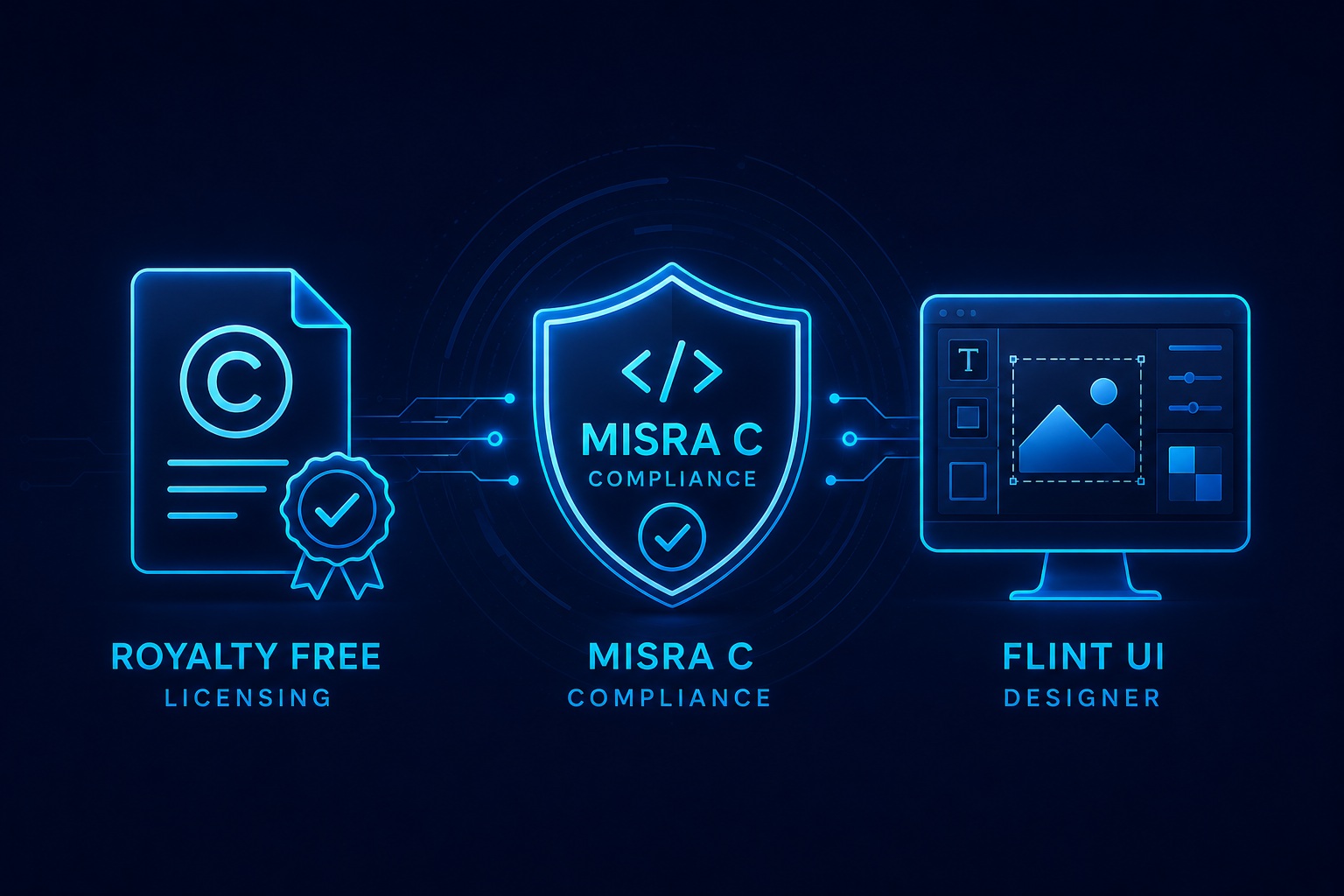
- No MISRA C compliance: LVGL uses dynamic memory allocation and contains constructs that fail MISRA C rules. For automotive, medical, and safety-critical industrial applications, this is a hard disqualification. Sparklet is fully MISRA C compliant.
- No professional design tool: SquareLine Studio handles basic widget placement but lacks the state machine authoring, animation timelines, and Figma import available in Flint UI Designer. Complex UI behaviours must still be hand-coded in C.
- Community-only support: No SLA, no direct engineering access. Sparklet customers talk directly to the engineers who built the framework.
- Dynamic memory at runtime: LVGL allocates from a heap at runtime. Sparklet uses static pools only — no fragmentation, no allocator failure paths, fully deterministic.
For teams shipping to automotive, medical, or industrial markets, Sparklet's total cost of ownership is lower than LVGL when compliance work, engineering hours, and support gaps are factored in. Full Sparklet vs LVGL comparison →
Sparklet vs Qt for MCUs: C vs C++, Royalty-Free vs Per-Unit
Qt for MCUs extends the Qt ecosystem to microcontrollers using C++ and QML. On MPU Linux platforms, Qt is an excellent choice. On MCU-class hardware at 16–256 KB RAM, three structural problems emerge:
- C++ runtime overhead: Vtables, runtime library, STL containers — all add code size and RAM usage that compounds on resource-constrained MCUs. Sparklet starts at 16 KB RAM with zero C++ overhead.
- No MISRA C compliance: C++ is fundamentally incompatible with MISRA C. For automotive (ISO 26262), medical (IEC 62304), and industrial safety (IEC 61508) applications, Qt for MCUs is excluded by language.
- Per-unit royalty: Qt charges per device shipped. At 500,000 units, this is a significant recurring BOM cost. Sparklet's developer-seat model is a fixed cost regardless of production volume.
For MCU-class devices where RAM is a constraint, safety certification is required, or volume economics are a factor, Sparklet's pure C, royalty-free, MISRA-compliant architecture is decisive. Full Sparklet vs Qt for MCUs comparison →
Sparklet vs TouchGFX: Silicon-Agnostic vs STM32 Lock-In
TouchGFX is STMicroelectronics' embedded GUI framework — free on STM32, built in C++, accelerated via DMA2D. For teams committed to the STM32 ecosystem it is a viable choice. For everyone else, the platform lock-in is a strategic risk:
- STM32-only support: TouchGFX is officially supported only on STM32. Porting to Renesas, NXP, Infineon, or other silicon requires unsupported, unmaintained effort. Teams on Sparklet swap the HAL layer and keep all widget and screen code unchanged.
- DMA2D dependency: Hardware acceleration on non-STM32 targets is unavailable. Sparklet integrates DMA2D, D/AVE2D (Renesas), Mali GPU, and Chrom-ART across multiple vendors.
- No MISRA C: TouchGFX is C++ — incompatible with MISRA C by definition. Automotive and safety-critical programmes cannot use it.
Sparklet runs the same UI codebase on Renesas RH850, NXP i.MX RT1170, STM32, Infineon TRAVEO T2G, and more — no re-implementation when silicon changes. Full Sparklet vs TouchGFX comparison →
Sparklet vs emWin: Design Tool Gap and Licensing Economics
emWin (SEGGER) is a mature, battle-tested commercial embedded GUI library with decades of production history in industrial and medical applications. It is technically solid — but two gaps consistently drive migration to Sparklet:
- No visual design tool: emWin has no WYSIWYG environment. Every screen is hand-coded in C — widget coordinates, pixel arithmetic, manual state transitions. Sparklet's Flint UI Designer reduces this to drag-and-drop, cutting UI development time by up to 70%.
- Per-unit royalty: emWin charges per device shipped. At production volumes of 100,000+ units, this is a significant ongoing BOM cost. Sparklet's developer-seat model fixes the licensing cost at project start — regardless of units shipped.
- Partial MISRA C: emWin offers partial MISRA C compliance. Sparklet is fully MISRA C compliant — important for programmes where full compliance is a hard customer or certification requirement.
For organisations using emWin, Sparklet offers a migration path that eliminates royalties, adds a professional design tool, and improves compliance — without sacrificing code quality. Full Sparklet vs emWin comparison →