The Five Embedded Display Interfaces
Technical deep-dive: when to use each interface, bandwidth limits, and Sparklet HAL integration.
RGB Parallel (TTL / LVTTL) — The Industrial TFT Workhorse
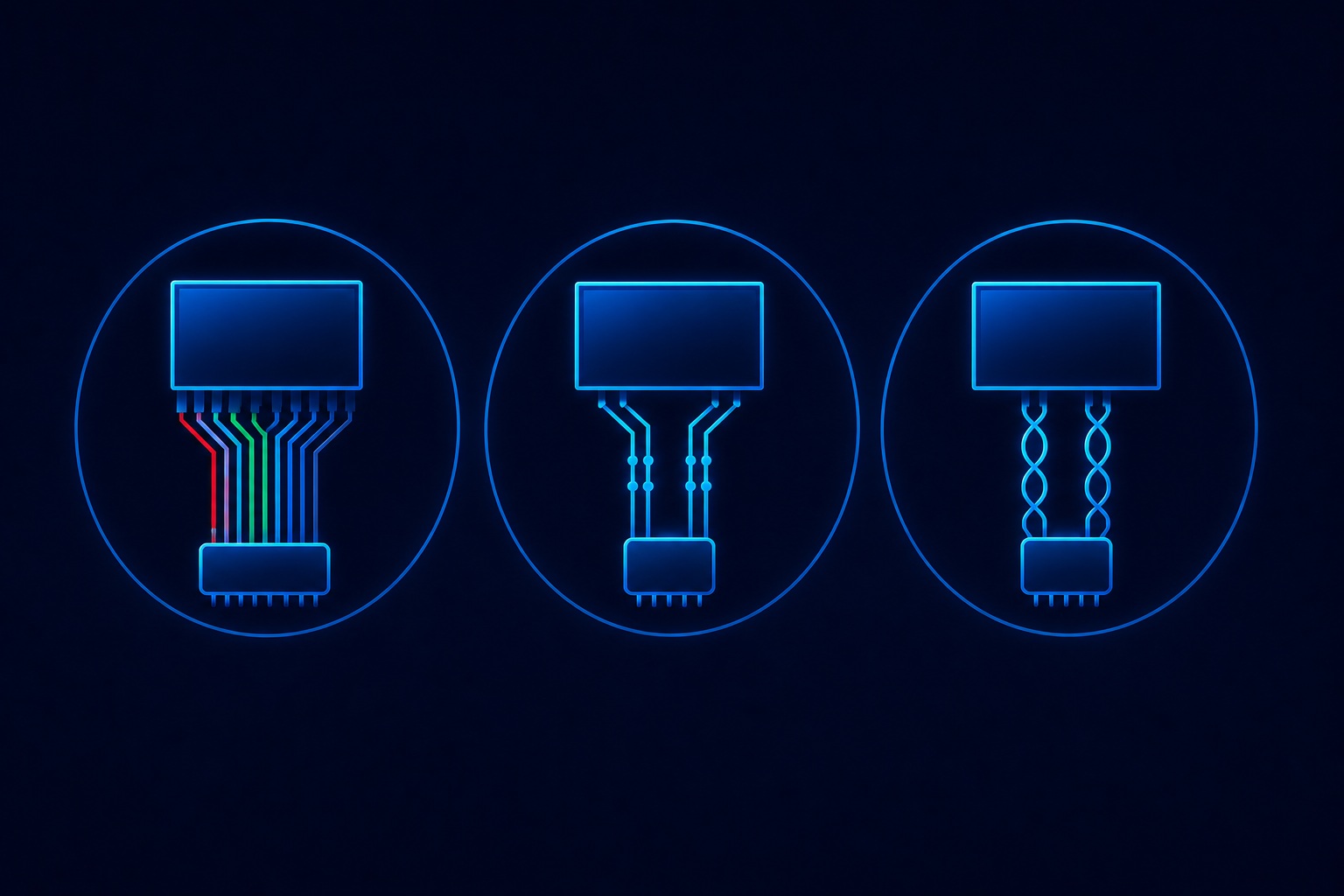
RGB parallel — also called TTL or LVTTL interface — is the classic high-bandwidth display connection used on 3.5" to 10" TFT LCD panels. The bus carries separate red, green, and blue pixel data lines (R[4:0], G[5:0], B[4:0] for 16-bit RGB565, or R[7:0], G[7:0], B[7:0] for 24-bit RGB888) plus synchronisation signals: HSYNC, VSYNC, PCLK, and DE. The MCU writes pixel data to a framebuffer in RAM; the display controller peripheral reads that framebuffer and drives the panel autonomously at the configured pixel clock rate.
RGB parallel requires a dedicated display controller peripheral: the LTDC on STM32 F4/H7/F7, the LCDC on NXP i.MX RT, or the DU on Renesas RA8D1 and RH850. Supported display resolutions reach 1024×768 or beyond in theory; in practice, MCU bandwidth and RAM limits the practical ceiling to 800×480 at 24-bit colour for a single 1 MB framebuffer on most Cortex-M7 MCUs.
Best for: 3.5"–10" TFT LCD panels in industrial HMI, automotive clusters, medical devices, and home automation where the display is mounted directly adjacent to the MCU PCB and PCB trace count (typically 24–40 signals) is not a constraint.
MIPI DSI — High-Bandwidth Serial for Modern OLED and Premium TFT
MIPI DSI (Mobile Industry Processor Interface — Display Serial Interface) transmits display data over 1 to 4 data lanes, each carrying up to 2.5 Gbps. The reduction from 24–40 parallel traces to 4–10 differential pairs dramatically simplifies PCB layout and enables longer cable runs — making MIPI DSI the preferred interface for modern OLED panels, high-density TFT displays, and any design where panel and main PCB are in different parts of the enclosure.
A 4-lane MIPI DSI link at 2.5 Gbps/lane delivers 10 Gbps of raw bandwidth — more than sufficient for 1080p at 60fps with 24-bit colour. MIPI DSI is available on NXP i.MX RT1170, NXP i.MX 8, Renesas RA8D1, and Rockchip RK3506G2. MIPI DSI operates in two modes: Video Mode (continuous pixel stream) and Command Mode (controller-based update, used for OLED with integrated GRAM — MCU sends updates only when screen content changes, saving power on wearables).
Best for: High-resolution displays (720p+), modern OLED panels, flex cable designs, and premium embedded HMI where PCB space and connector pin count are constrained.
LVDS — Differential Serial for Long-Cable Industrial Panels
LVDS (Low Voltage Differential Signalling) is a differential serial interface designed for driving medium to large TFT panels (7"–15") over cable runs of 30 cm or more. The differential pair signalling provides strong noise immunity — essential in industrial environments with motor drives, relay switching, and RF interference. An LVDS link carries the same colour data as RGB parallel but serialises it across 4 differential data pairs and a clock pair, reducing connector size and improving signal integrity over longer cables.
Most Cortex-M MCUs do not have a native LVDS output — they output RGB parallel or MIPI DSI and require an external LVDS serialiser IC (e.g., Texas Instruments SN65LVDS83) to convert parallel output to LVDS. MPUs running Linux (NXP i.MX 8, Rockchip) often include native single or dual LVDS output channels, capable of driving panels up to 1366×768 at 60fps per link. LVDS is particularly common on industrial open-frame panel monitors, medical imaging displays, and automotive head unit displays using 10"–12" panels.
Best for: 7"–15" industrial TFT panels, medical monitor displays, and designs where the display panel is 15–50 cm from the main processing board.
SPI / QSPI — The Universal Small-Display Interface
SPI (Serial Peripheral Interface) is the simplest display interface available on virtually every MCU — requiring only CS, CLK, and MOSI plus an optional DC line. SPI-connected display modules integrate the display driver IC, framebuffer, and panel into a single compact package. QSPI (Quad SPI) extends the bus to 4 data lines, quadrupling bandwidth.
SPI is bandwidth-limited: a standard 40 MHz clock delivers ~5 MB/s — sufficient for a 240×240 OLED at 30fps with RGB565, but not for larger panels. QSPI at 80 MHz improves this to ~40 MB/s, supporting 320×240 at 60fps or 480×320 at 30fps. Common SPI controller ICs: ST7789 (round OLED, smartwatch), ILI9341 (320×240 TFT), SH1106 (128×64 OLED), GC9A01 (circular 240×240 OLED). Sparklet's dirty-region renderer minimises pixel data written per frame on SPI displays by tracking only changed regions — reducing the average SPI transfer per frame significantly on typical UI workloads.
Best for: Wearable OLED displays, small secondary status panels, 1.3"–3.5" instrument panels, and any design where minimal MCU pin count is a requirement.
HDMI / DisplayPort — Standard Monitor Interfaces on Linux MPUs
HDMI and DisplayPort are the standard video output interfaces used on application-class MPUs running Embedded Linux or Android AOSP. NXP i.MX 8 series devices include HDMI 2.0 output capable of 4K60; Rockchip RK3506G2 provides HDMI and DisplayPort output. These interfaces connect directly to standard commercial monitors — giving embedded products access to a wide range of large-format display options without custom panel integration.
HDMI and DisplayPort are used in embedded products targeting a workstation or kiosk form factor — industrial control consoles, medical imaging review stations, casino gaming machines, digital signage kiosks, and premium point-of-sale terminals. Sparklet running on a Linux MPU with HDMI output uses the Mali GPU's OpenGL ES pipeline for hardware-accelerated rendering, enabling 3D widget content, video compositing, and multi-layer display output at full 1080p or 4K resolution. See hardware acceleration details for GPU integration on Linux MPU platforms.
Best for: Industrial workstation HMI, kiosk displays, medical imaging review stations, and digital signage on Linux MPUs where monitor form factor and VESA mounting apply.