MISRA C compliant, AUTOSAR-compatible embedded GUI for the TRAVEO T2G family. Sparklet harnesses TRAVEO's 2D graphics engine and VIDEOSS display controller for cluster, body domain, and HUD applications — royalty-free at automotive production volumes.
Sparklet is an embedded GUI library that runs on Infineon TRAVEO T2G automotive MCUs. The TRAVEO T2G family (CYT2B, CYT3B, CYT4B series) is Infineon's primary platform for automotive body domain controllers, door panel displays, instrument clusters, and head-unit HMI. These MCUs are designed to operate in ISO 26262 ASIL-B and ASIL-D safety contexts and are commonly integrated into AUTOSAR software stacks used by Tier 1 automotive suppliers.
Sparklet addresses the TRAVEO T2G display use case by providing a MISRA C compliant GUI library that integrates cleanly into an AUTOSAR-based software architecture. The Sparklet GUI task runs as a standard AUTOSAR SWC (Software Component) or as a dedicated RTOS task alongside the AUTOSAR OS. The HAL layer interfaces with TRAVEO T2G's LCD controller and 2D graphics engine, while the application and widget code above the HAL requires no platform-specific modification.
For the full list of supported platforms including other automotive and industrial MCUs, see the platform support overview.
The CYT2B is the entry-level TRAVEO T2G variant targeting body domain controllers, door panel displays, and seat control panels. It integrates a Cortex-M7 application core, ISO 26262 ASIL-B hardware safety features (ECC, BIST, watchdog), and a 2D graphics engine. Display resolutions in body domain applications typically run 320×240 to 480×272 — modest sizes matched to the CYT2B's RAM capacity and display engine bandwidth. Sparklet's CYT2B HAL configures the VIDEOSS display subsystem for RGB parallel output and maps Sparklet's framebuffer to the VIDEOSS layer memory. Touch input routes from the Peripheral Touch Controller (PTC) through the Sparklet HAL event queue. A typical CYT2B body domain Sparklet application fits comfortably within 256 KB RAM with the full widget library, screen definitions, and asset table.
The CYT3B targets digital instrument clusters and multi-zone interior displays. It adds a lockstep Cortex-R5 safety core alongside the Cortex-M7 application core — the R5 runs safety monitoring independently of the GUI rendering workload, enabling ASIL-D decomposition for instrument cluster safety contexts. The CYT3B's 2D graphics engine handles Sparklet widget rendering while the VIDEOSS video subsystem drives the main cluster display and can output a second safety overlay layer — warning icons, fault indicators — at the hardware compositing level without CPU intervention. Sparklet clusters on CYT3B typically target 7–10 inch panels at 800×480 or 1024×600 resolution. The Cortex-M7 at up to 320 MHz delivers sufficient compute for full-cluster animation with needle sweep, digit roll transitions, and bar graph updates running at 60 FPS when hardware acceleration handles blitting.
The CYT4B is the highest-performance TRAVEO T2G variant, targeting premium instrument clusters, central display controllers, and head-up display (HUD) systems in passenger vehicles. The CYT4B retains the R5+M7 dual-core safety architecture and adds higher clock speeds, additional RAM, and extended VIDEOSS capabilities including dual display output — useful for products with a main cluster display and a separate passenger or HUD output on the same MCU. Sparklet on CYT4B supports dual framebuffer operation: two independent Sparklet rendering contexts feed two VIDEOSS display channels. The Flint UI Designer supports dual-display project configurations, allowing designers to define both display layouts in a single project file and export a unified C code package for the CYT4B build. Toolchain support covers IAR Embedded Workbench, GCC ARM, and Green Hills MULTI — all qualified for AUTOSAR-based CYT4B projects.
| Variant | Safety Core | 2D GPU | Min RAM | Typical Cluster Grade |
|---|---|---|---|---|
| CYT2B (Body) | Cortex-M7 + safety HW | GE2D | 256 KB | ASIL-B body domain |
| CYT3B (Cluster) | Cortex-R5 lockstep + M7 | GE2D + VIDEOSS layer comp. | 512 KB | ASIL-D instrument cluster |
| CYT4B (High-End) | Cortex-R5 lockstep + M7 (high clock) | GE2D + dual VIDEOSS | 1 MB+ | ASIL-D cluster / HUD / dual display |
| Display Interface | RGB parallel, LVDS, MIPI-DSI (variant dependent) | Per VIDEOSS output module config. | — | Up to 1280×720 per channel |
Sparklet's source code is MISRA C compliant. This is a practical requirement for Tier 1 automotive suppliers integrating display software into TRAVEO T2G AUTOSAR software components, where the software quality standard typically mandates MISRA C compliance for all production code.
What MISRA C compliance means for TRAVEO T2G integration:
Important scope note: Sparklet is a display rendering library. It is not itself a certified ISO 26262 safety element and does not autonomously satisfy ASIL requirements. For safety-critical display applications on TRAVEO T2G — such as ASIL-B instrument clusters — the project safety plan must address how the display system (including Sparklet) is integrated within the overall safety architecture. Embien can provide documentation support for this integration. See the safety-critical HMI page for detailed guidance on Sparklet in safety-relevant embedded displays.
Sparklet integrates as a user application SWC within an AUTOSAR-compliant software architecture. The Sparklet GUI task interfaces with TRAVEO T2G's VIDEOSS, 2D graphics engine, and PTC through the Infineon peripheral driver layer — no AUTOSAR Basic Software modifications required. Compiles on IAR Embedded Workbench, GCC ARM, and Green Hills MULTI without toolchain qualification risk.

Speedometer, RPM, fuel, battery, warning icons, and navigation guidance on 7–12 inch TFT. VIDEOSS hardware layer carries safety overlays independently of the main cluster layer.

Door panels, seat controls, interior lighting. Lower resolution (320×240–480×272), strict BOM cost. TRAVEO T2G integrates CAN FD, LIN, touch, and display in a single MCU.

CYT4B drives HUD projector modules — speed, navigation arrow, ADAS alerts — as a low-latency display pipeline fed to the HUD projector controller.
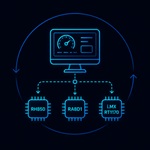
CYT2B, CYT3B, CYT4B portability requires only a HAL configuration change. Flint project files, screen code, and state machines are identical across TRAVEO T2G variants.


Flash the pre-built TRAVEO T2G evaluation binary to the CYT4BF EVK — confirms hardware compatibility and rendering performance before code integration. No toolchain setup required for initial evaluation.

Inspect the TRAVEO T2G VIDEOSS and PTC HAL source to assess integration effort with your AUTOSAR BSP. HAL functions are clearly separated — four functions per peripheral.

Use Flint UI Designer to build a prototype screen targeting your TRAVEO T2G display resolution. State machines, animations, and data bindings configured without writing C code.

Export C code from Flint and integrate into your IAR, GCC, or Green Hills toolchain project. Embien provides linker configuration examples for TRAVEO T2G AUTOSAR BSP environments.

Embien provides AUTOSAR integration guidance, MISRA C compliance reports, safety documentation support, and HAL customisation for non-standard display interfaces on TRAVEO T2G.
Sparklet is an embedded GUI library that runs on Infineon TRAVEO T2G automotive MCUs (CYT2B, CYT3B, CYT4B). It uses TRAVEO T2G's on-chip 2D graphics engine and VIDEOSS display controller, integrates with the Peripheral Touch Controller, and compiles with IAR, GCC, and Green Hills toolchains. The source code is MISRA C compliant and integrates into AUTOSAR-based software stacks.
Download the Sparklet evaluation binary for TRAVEO T2G — includes Flint UI Designer, TRAVEO T2G HAL source, automotive cluster and HMI sample projects, and AUTOSAR integration guidance.