RH850-Based Digital Instrument Cluster for Electric Two-Wheelers
Introduction
This case study examines the design and development of a full-color digital instrument cluster for a new generation of electric 2-wheelers. The primary goal was to deliver a premium, connected rider experience on a natively electric platform, setting the product apart in a highly competitive market.
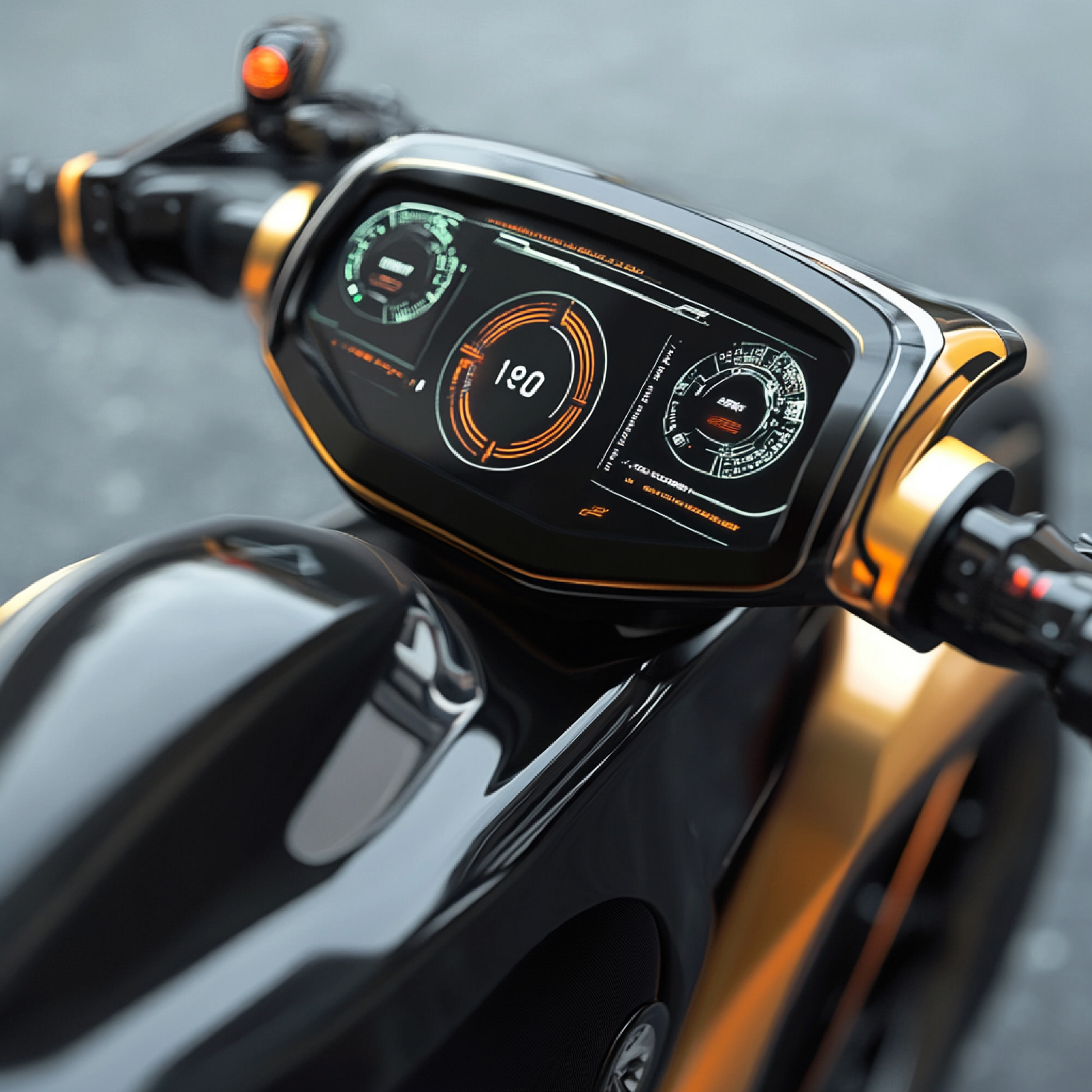
This new Electric 2-Wheeler Instrument Cluster needed to provide a modern, interactive, and informative UI tailored to the specific needs of a rider, such as State of Charge (SoC), Ride Modes, Regenerative Braking status, Remaining Range, and Turn-by-Turn Navigation alerts. The system was developed on the rugged, cost-effective Renesas RH850 microcontroller, with the complex UI and performance challenges being solved using the Sparklet GUI framework.
Platform Overview
The Renesas RH850/D1M1A MCU was selected as the target platform. This decision was based on its ideal balance of performance, cost, and rugged automotive-grade features, making it suitable for the demanding 2-wheeler environment.
Unlike more expensive application processors (MPUs), the RH850 is a microcontroller designed for real-time, safety-critical applications like a primary speedometer. Its key capabilities for this project included:
- High-Performance Core: A 32-bit core capable of managing real-time CAN bus data processing (from the BMS and motor controller), connectivity logic, and GUI tasks simultaneously.
- Integrated 2D Graphics Acceleration: The RH850 features a dedicated 2D graphics accelerator (sprite engine). This hardware can perform graphics operations—such as rotating gauge needles, alpha blending, and layer compositing—with zero CPU load.
- MIPI DSI Display Interface: This integrated interface allowed the MCU to directly drive a compact, high-brightness (sunlight-readable) TFT display (e.g., 480x272 or 800x480), reducing the bill-of-materials (BOM) cost and design complexity.
- Automotive-Grade Reliability: The platform is designed for the harsh, exposed 2-wheeler environment, including temperature extremes, constant vibration, and electrical instability.
This platform provided the necessary graphics hardware for a modern UI without the overhead, boot time, or cost of a full-fledged MPU.
Development Challenges
The development team faced significant challenges balancing a premium, connected UX with the strict cost and resource constraints of the 2-wheeler market.
- UI/UX Design: The primary challenge was extreme glanceability. On a scooter or motorcycle, the rider must assimilate critical information (speed, warnings, navigation) in a split second, often in direct, bright sunlight. The UI had to be high-contrast, clutter-free, and intuitive.
- Connectivity on a Small Screen: The cluster also needed to display smartphone-connected features (call alerts, music, turn-by-turn navigation) on a compact screen, demanding a highly efficient information architecture that didn't overwhelm the rider.
- Performance Optimization:
Limited Memory: The RH850 D1M1A has constrained on-chip Flash (for storing images, fonts, and code) and RAM (for frame buffers). A full-color frame buffer alone can consume a large portion of the available RAM.
Low CPU Load Requirement: The CPU’s primary responsibility was processing real-time vehicle data from the CAN bus (e.g., vehicle speed, BMS alerts, ride mode changes). The GUI could not cause processing lag, as a delayed speedometer or warning is a critical safety failure. - System Integration:
Data Synchronization: The UI had to display live data from the vehicle's BMS, motor controller, and a separate Bluetooth/connectivity module, all with minimal latency.
Power Stability: The cluster had to be fully robust against voltage drops and electrical noise, especially in a high-vibration environment, without flickering or resetting.
Solution Approach
To overcome these challenges, the team adopted the Sparklet GUI Framework, a solution specifically designed for lightweight rendering on MCUs with 2D graphics acceleration.
- Lightweight, Hardware-Accelerated Rendering: Sparklet’s architecture was built to offload rendering from the CPU to the RH850's 2D graphics hardware. Instead of the CPU calculating the pixels for a smooth gauge animation, Sparklet simply instructed the graphics engine to "draw this needle sprite at a 30-degree angle." This kept CPU load consistently low, reserving it for critical real-time tasks.
- Memory Optimization: Sparklet employed several key techniques to fit the premium design into the MCU's tight memory:
Compressed Assets: All graphical assets (images, fonts) were stored in a compressed format in Flash and were decompressed by Sparklet on-the-fly, minimizing RAM usage.
Incremental Refresh: Instead of redrawing the entire screen 30-60 times per second, Sparklet's engine tracked "dirty" regions. Only the parts of the UI that actually changed (e.g., the speed numbers or a navigation arrow) were redrawn. - Multi-Layer GUI Design: The UI was designed as a composite of multiple layers (e.g., static background, dynamic text/icons, animation layer). Sparklet's engine composited these layers in hardware, allowing, for example, a call alert to pop up over the main screen without forcing a redraw of the entire background.
- Real-Time Data Binding: Sparklet provided a clean data-binding API. The application's "backend" (the CAN and Bluetooth tasks) would update variables (e.g., g_vehicleSpeed, g_batterySoC, g_navTurnDistance). The Sparklet GUI engine, running independently, would automatically detect these changes and trigger the incremental refresh of the corresponding UI elements, ensuring a responsive and stable system.
Results & Benefits
The combination of the Renesas RH850 and the Sparklet framework delivered a final product that met all performance and cost targets.
- Fluid UI Performance with Low CPU Usage: The final cluster featured smooth, 60-fps animations for all gauges and transitions. Critically, the average CPU load remained below 20%, leaving ample processing power for vehicle logic and connectivity features.
- Drastically Reduced Resource Consumption: Sparklet’s optimized resource management resulted in a minimal Flash and RAM footprint. This allowed the OEM to use the cost-effective D1M1A-series MCU, lowering the overall BOM cost—a critical factor in the competitive 2-wheeler market.
- Premium Rider Experience: The final UI was bright, high-contrast, and highly responsive. Riders reported high satisfaction with the easy-to-read, "glanceable" display. The smooth integration of connected features (call/nav) significantly enhanced the product's premium value proposition.
- High Reliability & Stability: The system proved completely stable across all automotive test conditions, including extreme vibration, water ingress (IP67), and power instability, with an essential "instant-on" boot time.
Conclusion
This project successfully demonstrated that a premium, connected, and visually rich digital cluster can be delivered on a cost-effective, real-time MCU.
The synergistic combination of the Renesas RH850 MCU (providing the 2D graphics hardware) and the Sparklet GUI framework (providing the lightweight software to leverage it) was the key success factor. This approach allowed the 2-wheeler OEM to deploy a high-quality, reliable, and modern cluster for their flagship electric scooter line. The solution also proved to be highly scalable, allowing the OEM to easily adapt the core GUI design for different models (e.g., a low-cost commuter vs. a premium sport model) with minimal re-engineering.